what happened to the parents of st francis
| Saint Francis of Assisi OFM | |
|---|---|
 A portrait of Saint Francis past Philip Fruytiers | |
| Founder of the Franciscan Order, Confessor of the Faith and Stigmatist | |
| Born | Giovanni di Pietro di Bernardone 1181 or 1182 Assisi, Duchy of Spoleto, Holy Roman Empire |
| Died | 3 October 1226 (aged approximately 44 years) Assisi, Umbria, Papal States[1] |
| Venerated in |
|
| Canonized | 16 July 1228, Assisi, Papal States by Pope Gregory 9 |
| Major shrine | Basilica of San Francesco d'Assisi |
| Feast | 4 October |
| Attributes | Franciscan habit, birds, stigmata, crucifix, book, and a skull |
| Patronage | Franciscan Society, animals, merchants, ecology, stowaways, Naga, Cebu, Full general Trias, Cavite and Italy |

Francis of Assisi (born Giovanni di Pietro di Bernardone; Italian: Francesco d'Assisi; Latin: Franciscus Assisiensis; 1181 or 1182 – 3 Oct 1226), was an Italian Catholic friar, deacon, and mystic.[3] He founded the men's Gild of Friars Pocket-size, the women's Gild of St. Clare, the Third Order of St. Francis and the Custody of the Holy State. Francis is one of the most venerated religious figures in Christianity.[1]
Pope Gregory IX canonized Francis on sixteen July 1228. Forth with Catherine of Siena, he was designated patron saint of Italy. He later became associated with patronage of animals and the natural environment, and it became customary for churches to hold ceremonies blessing animals on his feast day of 4 October. In 1219, he went to Egypt in an attempt to convert the sultan al-Kamil and put an end to the conflict of the Fifth Cause.[4] Once his community was authorized past the Pope, he withdrew increasingly from external affairs.
Francis is known for his love of the Eucharist.[5] In 1223, Francis arranged for the get-go Christmas live nascence scene.[a] [6] [7] Co-ordinate to Christian tradition, in 1224 he received the stigmata during the apparition of a Seraphic angel in a religious ecstasy.[8]
Biography [edit]
Early life [edit]
Francis of Assisi was born in late 1181 or early 1182, ane of several children of an Italian father, Pietro di Bernardone dei Moriconi, a prosperous silk merchant, and a French female parent, Pica de Bourlemont, about whom little is known except that she was a noblewoman originally from Provence.[ix] Pietro was in France on business when Francis was born in Assisi, and Pica had him baptized equally Giovanni.[ten] Upon his render to Assisi, Pietro took to calling his son Francesco ("Gratuitous man", "Frenchman"), perhaps in accolade of his commercial success and enthusiasm for all things French.[11]
Indulged by his parents, Francis lived the high-spirited life typical of a wealthy young human.[8] Equally a youth, Francesco became a devotee of troubadours and was fascinated with all things Transalpine.[11] He was handsome, witty, gallant, and delighted in fine wearing apparel. He spent money lavishly.[7] Although many hagiographers remark about his bright vesture, rich friends, and love of pleasures,[9] his displays of disillusionment toward the world that surrounded him came fairly early in his life, as is shown in the "story of the ragamuffin". In this account, he was selling cloth and velvet in the market on behalf of his begetter when a beggar came to him and asked for alms. At the determination of his business deal, Francis abandoned his wares and ran afterward the ragamuffin. When he found him, Francis gave the man everything he had in his pockets. His friends mocked him for his charity; his father scolded him in rage.[12]
Around 1202, he joined a war machine expedition confronting Perugia and was taken as a prisoner at Collestrada, spending a yr every bit a captive.[13] An illness caused him to re-evaluate his life. Upon his return to Assisi in 1203, Francis returned to his carefree life. In 1205, Francis left for Apulia to enlist in the army of Walter Three, Count of Brienne. A strange vision made him return to Assisi and lose interest in the worldly life.[8] According to hagiographic accounts, thereafter he began to avert the sports and feasts of his former companions. A friend asked him whether he was thinking of marrying, to which he answered: "Yep, a fairer bride than any of you have ever seen", significant his "Lady Poverty".[7]
On a pilgrimage to Rome, he joined the poor in begging at St. Peter'due south Basilica.[8] He spent some time in lonely places, request God for spiritual enlightenment. He said he had a mystical vision of Jesus Christ in the forsaken country chapel of San Damiano, just outside Assisi, in which the Icon of Christ Crucified said to him, "Francis, Francis, go and repair My business firm which, equally yous tin meet, is falling into ruins." He took this to mean the ruined church in which he was presently praying, and then he sold some cloth from his father'southward store to help the priest there.[xiv] When the priest refused to accept the ill-gotten gains, an indignant Francis threw the coins on the flooring.[vii]
In order to avert his father'southward wrath, Francis hid in a cave near San Damiano for about a month. When he returned to town, hungry and dirty, he was dragged domicile by his male parent, beaten, jump, and locked in a small storeroom. Freed by his mother during Bernardone'south absence, Francis returned at one time to San Damiano, where he plant shelter with the officiating priest, but he was soon cited before the city consuls by his father. The latter, not content with having recovered the scattered gold from San Damiano, sought likewise to forcefulness his son to forego his inheritance by way of restitution. In the midst of legal proceedings before the Bishop of Assisi, Francis renounced his male parent and his patrimony.[7] Some accounts report that he stripped himself naked in token of this renunciation, and the bishop covered him with his own cloak.[15] [sixteen]
For the next couple of months, Francis wandered equally a beggar in the hills backside Assisi. He spent some fourth dimension at a neighbouring monastery working as a scullion. He so went to Gubbio, where a friend gave him, as an alms, the cloak, girdle, and staff of a pilgrim. Returning to Assisi, he traversed the city begging stones for the restoration of St. Damiano's. These he carried to the old chapel, set in place himself, and so at length rebuilt information technology. Over the course of two years, he embraced the life of a penitent, during which he restored several ruined chapels in the countryside around Assisi, amid them San Pietro in Spina (in the area of San Petrignano in the valley about a kilometer from Rivotorto, today on individual property and one time again in ruin); and the Porziuncola, the piddling chapel of St. Mary of the Angels in the plain just below the town.[vii] This later became his favorite abode.[fourteen] By degrees he took to nursing lepers, in the lazar houses virtually Assisi.
-

The house where Francis of Assisi lived when young
-
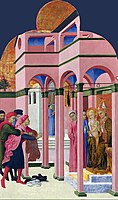
Saint Francis renounces his earthly begetter.
Founding of the Franciscan Orders [edit]
The Friars Small [edit]
One morning in February 1208, Francis was taking role in a Mass in the chapel of St. Mary of the Angels, near which he had past and so built himself a hut. The Gospel of the day was the "Commissioning of the Twelve" from the Volume of Matthew. The disciples were to go and proclaim that the Kingdom of God is at hand. Francis was inspired to devote himself to a life of poverty. Having obtained a fibroid woolen tunic, the clothes and so worn by the poorest Umbrian peasants, he tied information technology around himself with a knotted rope and went virtually exhorting the people of the countryside to penance, brotherly dear, and peace. Francis's preaching to ordinary people was unusual as he had no license to do and so.[1]
His example attracted others. Within a year Francis had xi followers. The brothers lived a unproblematic life in the deserted lazar house of Rivo Torto near Assisi; merely they spent much of their time wandering through the mountainous districts of Umbria, making a deep impression upon their hearers by their hostage exhortations.[7]
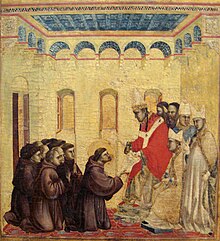
In 1209 he composed a unproblematic rule for his followers ("friars"), the Regula primitiva or "Archaic Dominion", which came from verses in the Bible. The rule was "to follow the teachings of our Lord Jesus Christ and to walk in his footsteps." He then led eleven followers to Rome to seek permission from Pope Innocent Iii to found a new religious order.[17] Upon entry to Rome, the brothers encountered Bishop Guido of Assisi, who had in his visitor Giovanni di San Paolo, the Cardinal Bishop of Sabina. The Central, who was the confessor of Pope Innocent 3, was immediately sympathetic to Francis and agreed to correspond Francis to the pope. Afterward several days, the pope agreed to admit the grouping informally, adding that when God increased the group in grace and number, they could render for an official audience. The group was tonsured.[18] This was of import in part because it recognized Church building authority and prevented his following from accusations of heresy, equally had happened to the Waldensians decades earlier. Though a number of the pope's counselors considered the mode of life proposed past Francis to exist dangerous and impractical, following a dream in which he saw Francis holding upwardly the Lateran Basilica, he decided to endorse Francis's order. This occurred, according to tradition, on 16 April 1210, and constituted the official founding of the Franciscan Social club.[1] The group, so the "Lesser Brothers" (Gild of Friars Small-scale also known as the Franciscan Order or the Seraphic Lodge), were centered in the Porziuncola and preached first in Umbria, before expanding throughout Italy.[ane] Francis was after ordained a deacon, just not a priest.[7]
The Poor Clares and the 3rd Order [edit]
From then on, the new guild grew quickly. Hearing Francis preaching in the church of San Rufino in Assisi in 1211, the immature noblewoman Clare of Assisi sought to live similar them. Her cousin Rufino also sought to bring together. On the night of Palm Sunday, 28 March 1212, Clare clandestinely left her family's palace. Francis received her at the Porziuncola and thereby established the Order of Poor Clares.[19] He gave Clare a religious habit, a garment similar to his own, earlier lodging her, her younger sis Caterina, and other young women in a nearby monastery of Benedictine nuns until he could provide a suitable monastery. Later he transferred them to San Damiano,[ane] to a few pocket-sized huts or cells. This became the get-go monastery of the Second Franciscan Order, now known equally Poor Clares.[7]
For those who could not leave their homes, Francis later formed the Third Society of Brothers and Sisters of Penance, a fraternity composed of either laity or clergy whose members neither withdrew from the world nor took religious vows. Instead, they observed the principles of Franciscan life in their daily lives.[one] Before long, the Third Order – at present titled the Secular Franciscan Order – grew beyond Italy.[twenty]
Travels [edit]
Determined to bring the Gospel to all peoples and let God convert them, Francis sought on several occasions to accept his message out of Italy. In the late spring of 1212, he prepare out for Jerusalem, only was shipwrecked past a tempest on the Dalmatian coast, forcing him to return to Italy. On viii May 1213, he was given the employ of the mountain of La Verna (Alverna) as a gift from Count Orlando di Chiusi, who described it as "eminently suitable for whoever wishes to do penance in a identify remote from flesh".[21] The mount would become i of his favourite retreats for prayer.[22]
In the same year, Francis sailed for Kingdom of morocco, but an illness forced him to break off his journey while in Spain.
In 1219, accompanied by Friar Illuminatus of Arce and hoping to convert the Sultan of Egypt or be martyred in the attempt, Francis went to Egypt during the Fifth Crusade where a Crusader army had been encamped for over a year besieging the walled metropolis of Damietta. The Sultan, al-Kamil, a nephew of Saladin, had succeeded his begetter equally Sultan of Egypt in 1218 and was encamped upstream of Damietta. A encarmine and futile attack on the metropolis was launched by the Christians on 29 August 1219, following which both sides agreed to a ceasefire which lasted four weeks.[23] It was most probably during this interlude that Francis and his companion crossed the Muslims' lines and were brought earlier the Sultan, remaining in his camp for a few days.[24] Reports requite no information about what transpired during the encounter beyond noting that the Sultan received Francis graciously and that Francis preached to the Muslims. He returned unharmed.[b] No known Arab sources mention the visit.[25]

Francis and others treating victims of leprosy or smallpox
Such an incident is alluded to in a scene in the late 13th-century fresco cycle, attributed to Giotto, in the upper basilica at Assisi.[c]
According to some tardily sources, the Sultan gave Francis permission to visit the sacred places in the Holy Land and even to preach at that place. All that can safely be asserted is that Francis and his companion left the Crusader camp for Acre, from where they embarked for Italy in the latter half of 1220. Cartoon on a 1267 sermon past Bonaventure, later sources report that the Sultan secretly converted or accepted a death-bed baptism as a effect of meeting Francis.[d]
Due to these events in Jerusalem, Franciscans have been present in the Holy Land near uninterruptedly since 1217. They received concessions from the Mameluke Sultan in 1333 with regard to certain Holy Places in Jerusalem and Bethlehem, and (so far as concerns the Catholic Church) jurisdictional privileges from Pope Clement VI in 1342.[26]
Reorganization of the Franciscan Order [edit]

The growing order of friars was divided into provinces; groups were sent to France, Federal republic of germany, Republic of hungary, and Spain and to the East. Upon receiving a report of the martyrdom of five brothers in Morocco, Francis returned to Italy via Venice.[27] Cardinal Ugolino di Conti was then nominated by the pope as the protector of the gild. Another reason for Francis' return to Italy was that the Franciscan Order had grown at an unprecedented rate compared to previous religious orders, but its organizational sophistication had non kept up with this growth and had trivial more than to govern it than Francis' case and elementary rule. To accost this problem, Francis prepared a new and more detailed Rule, the "First Rule" or "Rule Without a Papal Balderdash" (Regula prima, Regula non bullata), which over again asserted devotion to poverty and the apostolic life. However, it besides introduced greater institutional construction, though this was never officially endorsed by the pope.[1]
On 29 September 1220, Francis handed over the governance of the guild to Brother Peter Catani at the Porziuncola, but Peter died only five months subsequently.
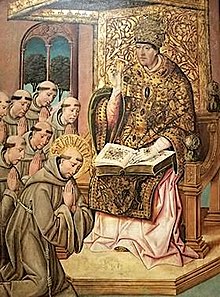
Brother Peter was succeeded past Blood brother Elias as Vicar of Francis. Two years afterwards, Francis modified the "Showtime Dominion", creating the "Second Rule" or "Dominion With a Bull", which was approved past Pope Honorius Iii on 29 November 1223. As the social club'south official rule, it called on the friars "to detect the Holy Gospel of our Lord Jesus Christ, living in obedience without anything of our own and in chastity". In addition, it set regulations for discipline, preaching, and entering the order. Once the rule was endorsed by the pope, Francis withdrew increasingly from external affairs.[1] During 1221 and 1222, he crossed Italy, first as far south as Catania in Sicily and afterward every bit far n as Bologna.[28]
Stigmata, concluding days, and sainthood [edit]

While he was praying on the mount of Verna, during a forty-day fast in training for Michaelmas (29 September), Francis is said to take had a vision on or well-nigh 13 September 1224, the Feast of the Exaltation of the Cantankerous, as a result of which he received the stigmata. Brother Leo, who had been with Francis at the time, left a clear and simple account of the event, the first definite account of the phenomenon of stigmata. "Suddenly he saw a vision of a seraph, a six-winged angel on a cantankerous. This affections gave him the gift of the five wounds of Christ."[31] Suffering from these stigmata and from trachoma, Francis received intendance in several cities (Siena, Cortona, Nocera) to no avail. In the end, he was brought back to a hut adjacent to the Porziuncola. Here he spent his last days dictating his spiritual testament. He died on the evening of Saturday, 3 Oct 1226, singing Psalm 141, "Voce mea advert Dominum".
On sixteen July 1228, he was declared a saint by Pope Gregory IX (the former cardinal Ugolino di Conti, a friend of Francis and Fundamental Protector of the Gild). The adjacent solar day, the pope laid the foundation stone for the Basilica of St. Francis in Assisi. Francis was buried on 25 May 1230, under the Lower Basilica, merely his tomb was soon hidden on orders of Brother Elias, in society to protect it from Saracen invaders. His burying place remained unknown until information technology was rediscovered in 1818. Pasquale Belli then constructed for the remains a catacomb in the Lower Basilica. It was refashioned betwixt 1927 and 1930 into its present form by Ugo Tarchi. In 1978, the remains of Francis were examined and confirmed by a committee of scholars appointed by Pope Paul 6, and put into a drinking glass urn in the ancient rock tomb.[32]
Character and legacy [edit]
Francis set out to imitate Christ and literally behave out his work. This is of import in understanding Francis' character, his affinity for the Eucharist and respect for the priests who carried out the sacrament.[ane] He preached: "Your God is of your flesh, He lives in your nearest neighbor, in every man."[33]
He and his followers celebrated and even venerated poverty, which was and so key to his character that in his final written work, the Testament, he said that absolute personal and corporate poverty was the essential lifestyle for the members of his order.[1]
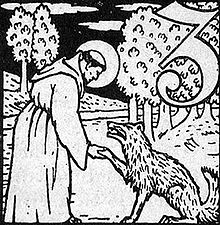
He believed that nature itself was the mirror of God. He chosen all creatures his "brothers" and "sisters", and even preached to the birds[34] [35] and supposedly persuaded a wolf in Gubbio to stop attacking some locals if they agreed to feed the wolf. His deep sense of brotherhood nether God embraced others, and he alleged that "he considered himself no friend of Christ if he did not cherish those for whom Christ died".[i]
Francis' visit to Egypt and attempted rapprochement with the Muslim earth had far-reaching consequences, long by his ain death, since later the fall of the Crusader Kingdom, information technology would be the Franciscans, of all Catholics, who would exist immune to stay on in the Holy Land and be recognized every bit "Custodians of the Holy Land" on behalf of the Cosmic Church.[36]
At Greccio near Assisi, around 1220, Francis celebrated Christmas by setting upward the commencement known presepio or crèche (Birth scene).[37] His nativity imagery reflected the scene in traditional paintings. He used real animals to create a living scene so that the worshipers could contemplate the birth of the child Jesus in a direct manner, making use of the senses, peculiarly sight.[37] Both Thomas of Celano and Bonaventure, biographers of Francis, tell how he used just a straw-filled manger (feeding trough) ready between a real ox and donkey.[37] According to Thomas, information technology was beautiful in its simplicity, with the manger acting as the altar for the Christmas Mass.[ citation needed ]
Nature and the environment [edit]
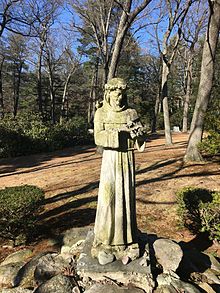
A garden statue of Francis of Assisi with birds
Francis preached the Christian doctrine that the world was created good and beautiful by God just suffers a need for redemption because of human sin. Every bit someone who saw God reflected in nature, "St. Francis was a great lover of God's creation ..."[38] In the Canticle of the Sunday he gives God thanks for Brother Sun, Sister Moon, Brother Wind, Water, Fire, and World, all of which he sees every bit rendering praise to God.[39]
Many of the stories that surround the life of Francis say that he had a great love for animals and the environment.[34] The "Fioretti" ("Little Flowers"), is a collection of legends and folklore that sprang up after his death. One account describes how one 24-hour interval, while Francis was travelling with some companions, they happened upon a place in the road where birds filled the trees on either side. Francis told his companions to "look for me while I go to preach to my sisters the birds."[34] The birds surrounded him, intrigued by the ability of his vox, and non one of them flew abroad. He is often portrayed with a bird, typically in his hand.[35]
Another fable from the Fioretti tells that in the metropolis of Gubbio, where Francis lived for some time, was a wolf "terrifying and ferocious, who devoured men as well as animals". Francis went up into the hills and when he found the wolf, he made the sign of the cantankerous and commanded the wolf to come up to him and hurt no 1. And then Francis led the wolf into the boondocks, and surrounded by startled citizens made a pact between them and the wolf. Because the wolf had "done evil out of hunger, the townsfolk were to feed the wolf regularly. In return, the wolf would no longer casualty upon them or their flocks. In this manner Gubbio was freed from the menace of the predator.[40]
On 29 November 1979, Pope John Paul Two declared Francis the patron saint of ecology.[41] On 28 March 1982, John Paul 2 said that Francis' love and care for creation was a challenge for gimmicky Catholics and a reminder "not to behave similar dissident predators where nature is concerned, merely to assume responsibility for it, taking all intendance so that everything stays healthy and integrated, so equally to offer a welcoming and friendly environment even to those who succeed the states."[42] The same Pope wrote on the occasion of the Earth Day of Peace, 1 January 1990, that Francis "invited all of creation – animals, plants, natural forces, fifty-fifty Brother Sunday and Sister Moon – to give honour and praise to the Lord. The poor man of Assisi gives us hit witness that when we are at peace with God we are improve able to devote ourselves to edifice upwards that peace with all creation which is inseparable from peace among all peoples."[43]
It is a popular exercise on his feastday, 4 October, for people to bring their pets and other animals to church building for a blessing.[44]
Feast day [edit]

Francis' final resting place at Assisi
Francis' feast day is observed on 4 October. A secondary banquet in honor of the stigmata received by Francis, celebrated on 17 September, was inserted in the General Roman Calendar in 1585 (later than the Tridentine Agenda) and suppressed in 1604, but was restored in 1615. In the New Roman Missal of 1969, it was removed once more from the General Agenda, as something of a duplication of the chief feast on 4 October, and left to the calendars of certain localities and of the Franciscan Order.[45] Wherever the Trindentine Missal is used, however, the feast of the Stigmata remains in the General Calendar.[46]
Francis is honored with a Lesser Festival in the Church building of England,[47] the Anglican Church of Canada, the Episcopal Church building USA, the Onetime Catholic Churches, the Evangelical Lutheran Church in America, and other churches and religious communities on iv October.[48] [49]
Papal name [edit]
On thirteen March 2013, upon his ballot equally Pope, Archbishop and Central Jorge Mario Bergoglio of Argentina chose Francis every bit his papal name in accolade of Francis of Assisi, becoming Pope Francis.[50] [51]
At his first audition on xvi March 2013, Pope Francis told journalists that he had called the name in honor of Francis of Assisi, and had washed and then because he was especially concerned for the well-beingness of the poor.[51] [52] [53] [54] The pontiff recounted that Cardinal Cláudio Hummes had told him, "Don't forget the poor", right afterward the election; that made Bergoglio think of Francis.[55] [56] It is the beginning time a pope has taken the name.[east]
Patronage [edit]

A relic of Francis of Assisi
On 18 June 1939, Pope Pius XII named Francis a joint patron saint of Italy along with Catherine of Siena with the apostolic letter of the alphabet "Licet Commissa".[58] Pope Pius also mentioned the ii saints in the acclamatory discourse he pronounced on 5 May 1949, in the Church of Santa Maria Sopra Minerva.[ citation needed ]
Francis is the patron of animals, merchants, and environmental.[59] He is also considered the patron against dying alone; confronting fire; patron of the Franciscan Club and Cosmic Action;[sixty] of families, peace, and needleworkers.[61] and a number of religious congregations.[threescore]
He is the patron of many churches and other locations around the world, including: Italia;[61] San Pawl il-Bahar, Malta; Freising, Germany; Lancaster, England; Kottapuram, Republic of india; San Francisco de Malabon, Philippines (General Trias Metropolis); San Francisco, California;[61] Santa Fe, New United mexican states; Colorado; Salina, Kansas; Metuchen, New Bailiwick of jersey; and Quibdó, Republic of colombia.
Outside Catholicism [edit]
Protestantism [edit]
Several Protestant groups have emerged since the 19th century that strive to adhere to the teachings of St. Francis.[62]
1 of the results of the Oxford Move in the Anglican Church building during the 19th century was the re-institution of religious orders, including some of Franciscan inspiration. The chief Anglican communities in the Franciscan tradition are the Community of St. Francis (women, founded 1905), the Poor Clares of Reparation (P.C.R.), the Social club of St. Francis (men, founded 1934), and the Community of St. Clare (women, enclosed).[ citation needed ]
A U.S.-founded order within the Anglican world communion is the Seattle-founded guild of Clares in Seattle (Diocese of Olympia), The Petty Sisters of St. Clare.[63]
There are also some modest Franciscan communities inside European Protestantism and the Old Catholic Church. There are some Franciscan orders in Lutheran Churches,[64] including the Society of Lutheran Franciscans, the Evangelical Sisterhood of Mary, and the Evangelische Kanaan Franziskus-Bruderschaft (Kanaan Franciscan Brothers).[65]
The Anglican church retained the Catholic tradition of blessing animals on or near Francis' feast day of 4 Oct, and more recently Lutheran and other Protestant churches have adopted the practice.[66]
Orthodox churches [edit]
Francis' banquet is celebrated at New Skete, an Orthodox Christian monastic customs in Cambridge, New York.[67]
Other religions [edit]
Outside of Christianity, other individuals and movements are influenced by the example and teachings of Francis. These include the popular philosopher Eckhart Tolle, who has made videos on the spirituality of Francis.[68]
The interreligious spiritual community of Skanda Vale in Wales also takes inspiration from the example of Francis, and models itself as an interfaith Franciscan order.[69]
Main writings [edit]
- Canticum Fratris Solis or Laudes Creaturarum; Canticle of the Sun
- Prayer before the Crucifix, 1205 (extant in the original Umbrian dialect too as in a contemporary Latin translation)
- Regula not bullata, the Earlier Rule, 1221
- Regula bullata, the Later Dominion, 1223
- Testament, 1226
- Admonitions
For a complete list, run into The Franciscan Experience.[70]
Francis is considered the starting time Italian poet past some literary critics.[71] He believed commoners should exist able to pray to God in their own language, and he wrote oft in the dialect of Umbria instead of Latin.[72]
The bearding 20th-century prayer "Make Me an Musical instrument of Your Peace" is widely attributed to Francis, but in that location is no evidence for it.[73] [74]
In fine art [edit]
The Franciscan Guild promoted devotion to the life of Francis from his canonization onwards. The order commissioned many works for Franciscan churches, either showing him with sacred figures, or episodes from his life. There are large early fresco cycles in the Basilica of San Francesco d'Assisi, parts of which are shown to a higher place.
There are countless seventeenth- and eighteenth-century depictions of Saint Francis of Assisi and a musical angel in churches and museums throughout western Europe. The titles of these depictions vary widely, at times describing Francis as "consoled", "comforted", in "ecstasy" or in "rapture"; the presence of the musical angel may or may not be mentioned.[75]
- Francis of Assisi in fine art
-
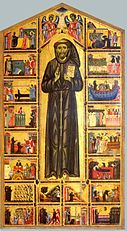
St. Francis and scenes from his life, 13th century
-

-

-

-

Saint Francis of Assisi in Ecstasy, Jusepe de Ribera, 1639
-

-
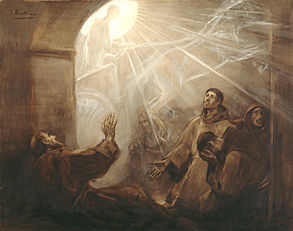
Francis of Assisi visiting his convent while far away, in a chariot of fire, José Benlliure y Gil (1855–1937)
Media [edit]
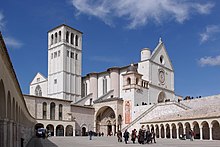
Basilica of St. Francis, Assisi

Statue of St. Francis in front end of the Cosmic church building of Chania.
Films [edit]
- The Flowers of St. Francis, a 1950 motion picture directed past Roberto Rossellini and co-written by Federico Fellini. Francis was played by Nazario Gerardi, a real-life Franciscan friar from the monastery Nocera Inferiore.
- Francis of Assisi, a 1961 picture directed past Michael Curtiz, based on the novel The Joyful Ragamuffin by Louis de Wohl, starring Bradford Dillman as Francis. Dolores Hart, who plays Clare, later became a real-life Franciscan nun.
- Francis of Assisi, a 1966 made-for-television film directed by Liliana Cavani, starring Lou Castel as Francis.
- The Hawks and the Sparrows, a 1966 film directed by Pier Paolo Pasolini
- Brother Sunday, Sister Moon, a 1972 film by Franco Zeffirelli, starring Graham Faulkner every bit Francis.
- Francesco, a 1989 film by Liliana Cavani, contemplatively paced, follows Francis of Assisi's evolution from rich man's son to religious humanitarian, and eventually to a full-fledged cocky-tortured saint. Francis is played by Mickey Rourke.
- St. Francis, a 2002 film directed by Michele Soavi, starring Raoul Bova as Francis.
- Clare and Francis, a 2007 picture directed by Fabrizio Costa, starring Mary Petruolo and Ettore Bassi
- Pranchiyettan and the Saint , a 2010 satirical Indian Malayalam film
- Finding St. Francis, a 2014 film directed past Paul Alexander
- Fifty'ami – François d'Assise et ses frères, a 2016 film directed by Renaud Fely and Arnaud Louvet, starring Elio Germano
- The Sultan and the Saint, a 2016 film directed by Alexander Kronemer, starring Alexander McPherson
- In Search of St. Francis of Assisi,[76] documentary featuring Franciscan monks and others
Music [edit]
- Franz Liszt:
- Cantico del sol di Francesco d'Assisi, S.4 (sacred choral work, 1862, 1880–81; versions of the Prelude for piano, South. 498c, 499, 499a; version of the Prelude for organ, South. 665, 760; version of the Hosannah for organ and bass trombone, Due south.677)
- St. François d'Assise: La Prédication aux oiseaux, No. i of Deux Légendes, S.175 (pianoforte, 1862–63)
- Gabriel Pierné: Saint François d'Assise (oratorio, 1912)
- William Henry Draper: All Creatures of Our God and King (hymn paraphrase of Canticle of the Sun, published 1919)
- Mario Castelnuovo-Tedesco: Fioretti (vox and orchestra, 1920)
- Gian Francesco Malipiero: San Francesco d'Assisi (soloists, chorus and orchestra, 1920–21)
- Hermann Suter: Le Laudi (The Praises) or Le Laudi di San Francesco d'Assisi, based on the Canticle of the Dominicus, (oratorio, 1923)
- Amy Beach: Canticle of the Sun (soloists, chorus and orchestra, 1928)
- Paul Hindemith: Nobilissima Visione (ballet 1938)
- Leo Sowerby: Canticle of the Sunday (cantata for mixed voices with accompaniment for pianoforte or orchestra, 1944)
- Francis Poulenc: Quatre petites prières de St. François d'Assise (men's chorus, 1948)
- Seth Bingham: The Anthem of the Sun (cantata for chorus of mixed voices with soli advertisement lib. and accompaniment for organ or orchestra, 1949)
- William Walton: Cantico del sol (chorus, 1973–74)
- Olivier Messiaen: St. François d'Assise (opera, 1975–83)
- Juliusz Łuciuk: Święty Franciszek z Asyżu (oratorio for soprano, tenor, baritone, mixed chorus and orchestra, 1976)
- Peter Janssens: Franz von Assisi, Musikspiel (Musical play, text: Wilhelm Wilms, 1978)
- Michele Paulicelli: Forza venite gente (musical theater, 1981)
- Karlheinz Stockhausen: Luzifers Abschied (1982), scene 4 of the opera Samstag aus Licht
- Libby Larsen: I Will Sing and Heighten a Psalm (SATB chorus and organ, 1995)
- Sofia Gubaidulina: Sonnengesang (solo cello, chamber choir and percussion, 1997)
- Juventude Franciscana: Balada de Francisco (voices accompanied by guitar, 1999)
- Angelo Branduardi : Fifty'infinitamente piccolo (anthology, 2000)
- Lewis Nielson: St. Francis Preaches to the Birds (chamber concerto for violin, 2005)
- Peter Reulein (composer) / Helmut Schlegel (libretto): Laudato si' (oratorio, 2016)
- Daniel Dorff: Flowers of St. Francis (solo for Bass Clarinet, 2013)
Books well-nigh Francis (selection) [edit]
Hundreds of books have been written most him. The following suggestions are from Franciscan friar Conrad Harkins (1935–2020), managing director of the Franciscan Institute at St. Bonaventure University.[77]
- Paul Sabatier, Life of St. Francis of Assisi (Scribner's, 1905).
- Johannes Jurgensen, St. Francis of Assisi: A Biography (translated past T. O'Conor Sloane; Longmans, 1912).
- Arnaldo Fortini, Francis of Assisi (translated by Helen Moak, Crossroad, 1981).
- John Moorman, St. Francis of Assisi (SPCK, 1963)
- John Moorman, The Spirituality of St. Francis of Assisi (Our Dominicus Company, 1977).
- Erik Doyle, St. Francis and the Song of Alliance (Seabury, 1981).
- Raoul Manselli, St. Francis of Assisi (translated by Paul Duggan; Franciscan, 1988).
Other [edit]
- In Rubén Darío's poem "Los Motivos Del Lobo " ("The Reasons of the Wolf") St. Francis tames a terrible wolf only to discover that the human being centre harbors darker desires than those of the beast.
- In Fyodor Dostoyevsky'due south The Brothers Karamazov, Ivan Karamazov invokes the name of "Pater Seraphicus", an epithet practical to St. Francis, to describe Alyosha'due south spiritual guide Zosima. The reference is found in Goethe'southward Faust, Part two, Deed five, lines xi,918–25.[78]
- In Mont St. Michel and Chartres, Henry Adams' chapter on the "Mystics" discusses Francis extensively.
- Francesco's Friendly Earth was a 1996–97 direct-to-video Christian animated serial produced past Lyrick Studios that was about Francesco and his talking animal friends equally they rebuild the Church of San Damiano.[79]
- Rich Mullins co-wrote Canticle of the Plains, a musical, with Mitch McVicker. Released in 1997, it was based on the life of St. Francis of Assisi, merely told every bit a Western story.
- Bernard Malamud'south novel The Banana (1957) features a protagonist, Frank Alpine, who exemplifies the life of St. Francis in mid-20th-century Brooklyn, New York Urban center.
See also [edit]
- Feast of Saint Francis
- St. François d'Assise, an opera by Olivier Messiaen
- Blessing of animals
- Fraticelli
- List of places named subsequently St. Francis
- Pardon of Assisi
- St. Francis of Assisi, patron saint annal
- St. François (disambiguation), places named after Francis of Assisi in French-speaking countries
- Social club of St. Francis
- St. Benedict's Cave, which contains a portrait of Francis made during his lifetime
- St. Juniper, i of Francis' original followers
- Wolf of Gubbio
Prayers [edit]
- Canticle of the Sun, a prayer past Francis
- Little Role of the Passion, composed by Francis
- Prayer of St. Francis, a prayer often misattributed to Francis
References [edit]
Notes [edit]
- ^ The Christmas scenes made past Saint Francis at the time were non inanimate objects, just live ones, later commercialised into inanimate representations of the Blessed Lord and His parents.
- ^ east.g., Jacques de Vitry, Letter 6 February or March 1220 and Historia orientalis (c. 1223–1225) cap. XXII; Tommaso da Celano, Vita prima (1228), §57: the relevant passages are quoted in an English translation in Tolan 2009, pp. xix– and Tolan 2009, p. 54 respectively.
- ^ e.grand., Chesterton, Saint Francis, Hodder & Stoughton (1924) chapter 8. Tolan 2009, p. 126 discusses the incident as recounted by Bonaventure, an incident which does not extend to a burn down really being lit.
- ^ For grants of diverse permissions and privileges to Francis as attributed past after sources, see, e.1000., Tolan 2009, pp. 258–263. The first mention of the Sultan'south conversion occurs in a sermon delivered by Bonaventure on iv Oct 1267. See Tolan 2009, p. 168
- ^ On the day of his election, the Vatican clarified that his official papal name was "Francis", not "Francis I". A Vatican spokesman said that the name would become Francis I if and when there is a Francis II.[53] [57]
Citations [edit]
- ^ a b c d east f g h i j k l Brady & Cunningham 2020.
- ^ Brooke 2006, pp. 161–162.
- ^ Delio 2013.
- ^ Tolan 2009.
- ^ "St. Francis of Assisi – Franciscan Friars of the Renewal". Franciscanfriars.com. Archived from the original on 15 December 2019. Retrieved 24 Oct 2012.
- ^ Herbermann, Charles, ed. (1913). . Cosmic Encyclopedia. New York: Robert Appleton Visitor.
- ^ a b c d e f grand h i Herbermann, Charles, ed. (1913). . Cosmic Encyclopedia. New York: Robert Appleton Company.
- ^ a b c d Cross, F. L., ed. (2005). "Francis of Assisi". The Oxford lexicon of the Christian church. New York: Oxford University Printing. ISBN0199566712.
- ^ a b Englebert, Omer (1951). The Lives of the Saints. New York: Barnes & Noble. p. 529. ISBN978-1-56619-516-iv.
- ^ Dagger, Jacob (November–Dec 2006). "Approval All Creatures, Great and Pocket-sized". Knuckles Magazine . Retrieved 1 December 2019.
- ^ a b Chesterton, Gilbert Keith (1924). "St. Francis of Assisi" (xiv ed.). Garden City, New York: Image Books: 158.
- ^ Chesterton (1924), pp. 40–41
- ^ a b Chesterton (1924), pp. 54–56
- ^ de la Riva, Fr. John (2011). "Life of St. Francis". St. Francis of Assisi National Shrine . Retrieved 11 June 2019.
- ^ Kiefer, James E. (1999). "Francis of Assisi, Friar". Biographical sketches of memorable Christians of the past . Retrieved xi June 2019.
- ^ Chesterton (1924), pp. 107–108
- ^ Galli(2002), pp. 74–80
- ^ Chesterton (1924), pp. 110–111
- ^ "Secular Franciscan Gild". Secular Franciscan Order Usa . Retrieved thirteen January 2021.
- ^ Fioretti quoted in: St. Francis, The Little Flowers, Legends, and Lauds, trans. N. Wydenbruck, ed. Otto Karrer (London: Sheed and Ward, 1979) 244.
- ^ Chesterton (1924), p. 130
- ^ Runciman, Steven. History of the Crusades, vol. 3: The Kingdom of Acre and the Later on Crusades, Cambridge Academy Press (1951, paperback 1987), pp. 151–161.
- ^ Tolan 2009, pp. iv–.
- ^ Tolan 2009, p. 5.
- ^ Bulla Gratias agimus, commemorated by Pope John Paul Two in a Letter dated xxx November 1992. Come across also Tolan 2009, p. 258. On the Franciscan presence, including an historical overview, see, generally the official website at Custodia and Custodian of the Holy Land
- ^ Bonaventure (1867), p. 162
- ^ Ruggeri, Francesco Rocco (2018). Sicilian Visitors Book 2. ISBN978-1-387-97789-5.
- ^ Le Goff, Jacques. Saint Francis of Assisi, 2003 ISBN 0-415-28473-2 p. 44
- ^ Miles, Margaret Ruth. The Word made flesh: a history of Christian thought, 2004 ISBN 978-1-4051-0846-i pp. 160–161
- ^ Chesterton (1924), p. 131
- ^ "Key to Umbria: Assisi". world wide web.keytoumbria.com . Retrieved 9 May 2021.
- ^ Eimerl, Sarel (1967). The Globe of Giotto: c. 1267–1337 . et al. Time-Life Books. p. fifteen. ISBN0-900658-15-0.
- ^ a b c Bonaventure (1867), pp. 78–85
- ^ a b Ugolino Brunforte (Blood brother Ugolino) (1958). The Little Flowers of St. Francis of Assisi. Calvin College: CCEL. ISBN978-1-61025212-6.
Quote.
- ^ "Custody of the Holy Land". terrasanta.edu.jo . Retrieved nine May 2021.
- ^ a b c Bonaventure (1867), p. 178
- ^ Warner OFM, Keith (Apr 2010). "St. Francis: Patron of ecology". U.Due south. Cosmic. 75 (4): 25.
- ^ Doyle, Eric (1996). St. Francis and the Song of Brotherhood and Sisterhood. Franciscan Constitute. ISBN978-1576590034.
- ^ Hudleston, Roger, ed. (1926). The Little Flowers of Saint Francis. Archived from the original on v July 2019. Retrieved xix September 2014.
- ^ Pope John Paul 2 (29 November 1979). "Inter Sanctos (Apostolic Letter AAS 71)" (PDF). Archived from the original (PDF) on 9 August 2014. Retrieved vii August 2014.
- ^ Pope John Paul Ii (28 March 1982). "Angelus". Retrieved 9 June 2020.
- ^ Pope John Paul Ii (8 December 1989). "Earth Mean solar day of Peace 1990". Retrieved 24 October 2012.
- ^ Pappas, William. "The Patron Saint of Animals and Ecology", Earthday.org, Oct 6, 2016
- ^ Calendarium Romanum (Libreria Editrice Vaticana), p. 139
- ^ "The Stigmata of Saint Francis, Appearing and Disappearing in the Liturgy". Retrieved 9 May 2021.
- ^ "The Agenda". The Church building of England . Retrieved 9 Apr 2021.
- ^ "St. Francis of Assisi". St. Francis of Tejas Church . Retrieved 2 February 2021.
- ^ Robinson, Michael (1999). St. Francis of Assisi: The Legend and the Life. Swell Britain: A&C Black. p. 267. ISBN0-225-66736-3.
- ^ Pope Francis (16 March 2013). "Audience to Representatives of the Communications Media". Retrieved 9 August 2014.
- ^ a b Marotta, Giulia (2016). "Revolutionary Monasticism?: Franciscanism and Ecclesiastical Hierarchy every bit a Hermeneutic Dilemma of Contemporary Catholicism". In Hunt, Stephen J. (ed.). Handbook of Global Contemporary Christianity: Movements, Institutions, and Allegiance. Brill Handbooks on Contemporary Religion. Vol. 12. Leiden: Brill Publishers. pp. 165–184. doi:10.1163/9789004310780_009. ISBN978-90-04-26539-4. ISSN 1874-6691.
- ^ "Pope Francis explains conclusion to take St Francis of Assisi's name". The Guardian. London. xvi March 2013. Archived from the original on 17 March 2013.
- ^ a b "New Pope Francis visits St. Mary Major, collects suitcases and pays bill at hotel". News.va. fourteen March 2013. Archived from the original on 17 March 2013. Retrieved 4 January 2017.
- ^ Michael Martinez, CNN Vatican analyst: Pope Francis' name choice 'precedent shattering', CNN (13 March 2013). Retrieved 13 March 2013.
- ^ Laura Smith-Spark et al. : Pope Francis explains name, calls for church 'for the poor' CNN,16 March 2013
- ^ "Pope Francis wants 'poor Church for the poor'". BBC News. BBC. 16 March 2013. Retrieved 16 March 2013.
- ^ Alpert, Emily (thirteen March 2013). "Vatican: Information technology's Pope Francis, not Pope Francis I". Los Angeles Times. Archived from the original on 15 March 2013. Retrieved 4 January 2017.
- ^ Pope Pius XII (18 June 1939). "Licet Commissa" (Apostolic Letter AAS 31, pp. 256–257)
- ^ "Saint Francis of Assisi". Franciscan Media . Retrieved 20 March 2019.
- ^ a b "Feast of St. Francis of Assisi", Catholic News Service, October 4, 2018
- ^ a b c "Saint Francis of Assisi", Newman Connection
- ^ Heimann, Mary (May 2017). "The secularisation of St Francis of Assisi". British Catholic History. 33 (3): 401–420. doi:10.1017/bch.2017.iv. ISSN 2055-7973.
- ^ "The Piddling Sisters of St. Clare". Archived from the original on 2 September 2010. Retrieved 16 April 2019.
- ^ "Order of Lutheran Franciscans". Lutheranfranciscans.org. Retrieved 20 June 2015.
- ^ Robson, Michael J. P. (2011). The Cambridge Companion to Francis of Assisi. Cambridge University Printing. ISBN9780511978128.
- ^ Elation, Peggy Ann (3 Oct 2019). "Animals to be blessed Sabbatum at Episcopal Cathedral" (PDF). The San Juan Daily Star. p. 20. Archived from the original (PDF) on 7 October 2019. Retrieved 6 October 2019.
- ^ "Events, New Skete Monastery". newskete.org.
- ^ "St Francis of Assisi – What is Perfect Joy!". Eckhart Tolle Now . Retrieved 26 June 2019.
- ^ "Skanda Vale – Oft asked questions". Skanda Vale . Retrieved 14 Nov 2018.
- ^ "Writings of St. Francis – Part two". Archived from the original on 28 January 2013. Retrieved 17 January 2013.
- ^ Brand, Peter; Pertile, Lino, eds. (1999). "two – Poesy. Francis of Assisi (pp. 5ff.)". The Cambridge History of Italian Literature. Cambridge University Press. ISBN978-0-52166622-0 . Retrieved 31 December 2015.
- ^ Chesterton, One thousand.K. (1987). St. Francis. Paradigm. pp. 160 p. ISBN0-385-02900-4. Archived from the original on 12 August 2013.
{{cite book}}: CS1 maint: bot: original URL condition unknown (link) - ^ Renoux, Christian (2001). La prière pour la paix attribuée à saint François: une énigme à résoudre. Paris: Editions franciscaines. ISBNii-85020-096-4.
- ^ Renoux, Christian. "The Origin of the Peace Prayer of St. Francis". Retrieved 9 August 2014.
- ^ Roberts, Holly (2020). "The Musical Rapture of Saint Francis of Assisi: Hagiographic Adaptations and Iconographic Influences". Music in Fine art: International Journal for Music Iconography. 45 (one–ii): 72–86. ISSN 1522-7464.
- ^ In Search of Saint Francis of Assisi, Light-green Apple Entertainment. Retrieved 20 December 2019.
- ^ Harkins, Conrad (1994). "Francis of Assisi: Recommended Resources". Christianity Today. Archived from the original on 11 April 2021. Retrieved 11 Apr 2021.
- ^ Медведев, Александр (2015). ""Сердце милующее": образы праведников в творчестве Ф. М. Достоевского и св. Франциск Ассизский". Известия Уральского федерального университета. Серия ii: Гуманитарные науки. №two (139): 222–233. Retrieved 11 July 2019 – via www.academia.edu.
- ^ "Mark Bernthal" (Video). www.markbernthal.com.
Sources [edit]
- Brady, Ignatius Charles; Cunningham, Lawrence (29 September 2020). "St. Francis of Assisi". Encyclopædia Britannica. Encyclopædia Britannica, Inc. Retrieved 5 October 2020. .
- Brooke, Rosalind B. (2006). The Image of St Francis: Responses to Sainthood in the Thirteenth Century. Cambridge: University Printing.
- Delio, Ilia (20 March 2013). "Francis of Assisi, nature'southward mystic". The Washington Mail service. .
- Scripta Leonis, Rufini et Angeli Sociorum Southward. Francisci: The Writings of Leo, Rufino and Angelo Companions of St. Francis, original manuscript, 1246, compiled by Brother Leo and other companions (1970, 1990, reprinted with corrections), Oxford: Oxford Academy Printing, edited by Rosalind B. Brooke, in Latin and English, ISBN 0-19-822214-ix, containing testimony recorded by intimate, longtime companions of St. Francis.
- Francis of Assisi, The Little Flowers (Fioretti), London, 2012. limovia.cyberspace ISBN 978-i-78336-013-0.
- Bonaventure; Cardinal Manning (1867). The Life of St. Francis of Assisi (from the Legenda Sancti Francisci) (1988 ed.). Rockford, Illinois: TAN Books & Publishers ISBN 978-0-89555-343-0.
- Chesterton, Gilbert Keith (1924). St. Francis of Assisi (14th ed.). Garden Urban center, New York: Image Books.
- Englebert, Omer (1951). The Lives of the Saints. New York: Barnes & Noble.
- Karrer, Otto, ed., St. Francis, The Little Flowers, Legends, and Lauds, trans. N. Wydenbruck, (London: Sheed and Ward, 1979).
- Tolan, John 5. (2009). Saint Francis and the Sultan: The Curious History of a Christian-Muslim Run across. Oxford: University Press. ISBN978-0-19-923972-6. .
Further reading [edit]
- Acocella, Joan (fourteen January 2013). "Rich Man, Poor Man: The Radical Visions of St. Francis". The New Yorker. Vol. 88, no. 43. pp. 72–77. Retrieved 23 January 2015. .
- Brady, Kathleen (2021). Francis and Clare: the Struggles of the Saints of Assisi. Lodwin Press, New York. ISBN978-1737549826.
- The Piddling Flowers [Fioretti] of Saint Francis (Translated by Raphael Brown), Doubleday, 1998. ISBN 978-0-385-07544-2.
- Valerie Martin, Salvation: Scenes from the Life of St. Francis, New York: Alfred A. Knopf, 2001. ISBN 0-375-40983-one.
- Giovanni Morello and Laurence B. Kanter, eds., The Treasury of Saint Francis of Assisi, Electa, Milan, 1999. Itemize of exhibition at the Metropolitan Museum of Art, March 16-June 27, 1999.
- Paul Moses, The Saint and the Sultan: The Crusades, Islam, and Francis of Assisi's Mission of Peace, New York: Doubleday, 2009.
- Donald Spoto, Reluctant Saint: The Life of Francis of Assisi, New York: Viking Compass, 2002. ISBN 0-670-03128-3.
External links [edit]
- "St. Francis of Assisi", Encyclopædia Britannica online
- "St. Francis of Assisium, Confessor", Butler's Lives of the Saints
- The Franciscan Archive
- St. Francis of Assisi – Catholic Saints & Angels
- Hither Followeth the Life of St. Francis from Caxton'due south translation of the Golden Legend
- Pillar Statue in St. Peter's Foursquare
- Founder Statue in St. Peter'south Basilica
- "The Poor Human being of Assisi". Invisible Monastery of charity and fraternity – Christian prayer group. Archived from the original on 23 March 2018.
- Works past or about Francis of Assisi at Internet Archive
- Works by Francis of Assisi at LibriVox (public domain audiobooks)

Source: https://en.wikipedia.org/wiki/Francis_of_Assisi
0 Response to "what happened to the parents of st francis"
Post a Comment