Wolf Nature Predator Hunter Family Howling Wolves Figurine Statue Collectible
LONGFORM
In search of
Japan'southward lost wolves
Territorial threat
Japanese cedar and cypress forests in the Okuchichibu mountains | THOMAS DELSOL / HANS LUCAS
Industrialization and deforestation played a function in the Japanese wolf's supposed demise at the plow of the 20th century. More than than 100 years later, the ecological crisis is still with u.s.a..
ALEX Chiliad.T. MARTIN
Staff writer
Glaring ominously over rice paddies, chestnut fields and apple tree orchards dotting Japan'southward rural mural, shaggy mechanical beasts with flashing carmine eyes and bared fangs are doing what the animate being they're modeled later on can no longer be counted on — protecting farmland from a booming population of wildlife pests such as deer, wild boar and bears.
Called "Monster Wolf," these robotic canines are the brainchild of Ohta Seiki Co. and were created in response to the growing menace of crop raiders that inflict billions of yen in damages annually. The solar battery-powered wolf can plow its caput from side to side and make dozens of varieties of howling, barking and gunshot sounds when the motility detectors are activated.
"Some retrieve this is merely a gimmick, only the results so far testify it'due south working," says Shushi Sasaki, managing director of Wolf Kamuy, the visitor in accuse of Monster Wolf's sales and maintenance. Indeed, sightings of wild bears rummaging for food in Takikawa, a city in Hokkaido, accept dropped drastically since they were introduced terminal year. Like success stories are reported in dozens of locations across the nation where the metal wolves take been deployed.
Ohta Seiki Co.'s Monster Wolf was invented to scare away crop raiders.| COURTESY OF WOLF KAMUY
Only why does the motorcar take the form of a wolf, an brute believed to have disappeared from Japan over a century ago?
"Ohta Seiki initially sold a pest repellent combining flashing LED lights with blazing sounds, but realized the product could be more effective with a threatening outward appearance," Sasaki says. "Zoologists advised that the wolf was the natural predator of wild bears and other animals, so we proceeded to experiment with the Yezo deer kept by the Tokyo University of Agriculture's Okhotsk campus in Hokkaido."
Mayhap it's embedded in their Dna. The deer were petrified by the robot's frightening looks, Sasaki says, and the mechanism company found itself a striking production.
Before its supposed extinction in the late 19th to early 20th centuries, the wolf presided over the archipelago as an apex predator, worshipped by farmers as guardian of the field for preying on deer, wild boar and many other animals.
In its absence, withal, and with climate change, a decrease in the numbers of hunters and a government-led program that replaced massive swaths of native forests with secondary forests, Nippon has seen a rapid proliferation of voracious herbivores and omnivores such as deer and wild boar that ravage scenic woodlands. The all-encompassing damage to agronomics and the surroundings has led non only to the invention of the Monster Wolf, but also to calls for reintroducing real wolves into Nippon to restore the country's ecosystem.
License to kill
Sitting in a cedar forest behind my family'south weekend retreat are a couple of trail cameras I installed on tree trunks — tiny windows into the ecological mural of the world'southward tertiary largest economy.
The two-story house sits on the outskirts of Chichibu, a mountain-ringed province on the northwestern edge of Saitama Prefecture. Home to impressive peaks and ancient villages with numerous trails leading up into the highlands, the region — known for its history of wolf worship — teems with wildlife, attracting fans of hiking, fishing, rafting and, during the annual hunting season that kicks off on Nov. xv, those with gun and trap licenses looking for game.
And in that location are enough — perhaps too many when it comes to certain crop raiders such as deer and wild boar.
Lacking both fiscal and human resources to kill those pests, crumbling and shrinking municipalities are struggling to deal with the animals' expanding population and the damage they inflict. Nationally, that effigy was ¥fifteen.8 billion in 2019, with deer, wild boar and monkeys accounting for ¥5.3 billion, ¥4.vi billion and ¥900 meg, respectively.
Hunters work to choose the herds, of grade. Nonetheless, after hit a high of 518,000 in 1975, the full number of licensed hunters plunged — finally leveling off effectually the 200,000 marker in recent years, according to the Environment Ministry.
In 2016, for instance, the ministry counted 199,700 registered hunters. However, around 60% of those were over 60 years old, raising concerns that many elderly hunters will be retiring their guns in the coming years.
"Virtually hunters hither are in their 70s," says Takeo Koike, head of the Arakawa branch of the 29-fellow member Okuchichibu Ryoyukai hunting clan. "I know a man who is 90 years old who yet goes out with his shotgun. It's getting difficult to recruit the younger generation."
Koike's family has lived for centuries on a plot of land nigh a kilometer from our house. The area was called Arakawa Village earlier existence merged into the city of Chichibu in 2005. Its sometime name was a nod to how the community is nestled near a steep valley leading downwardly to the Arakawa, a 173-kilometer river that originates on Mountain Kobushi in Chichibu and empties into Tokyo Bay.
Wearing a bright orange belong, Koike, who is almost 70, tells me at my Chichibu residence that he acquired a hunting license when he was 50 after wild boar trampled and destroyed a path leading up to his family's gravesite. "It prevented the states from paying respect to our ancestors, and so I decided to take matters into my own easily."
After passing an test that involved both written and applied assessments, Koike received permits to trap and possess sporting guns and purchased his gear at a local gun shop. He uses a shotgun with 9-pellet shells, an airgun and wire traps that sell for around ¥v,000 to ¥8,000 a set.
Outside of the official hunting flavor that ends on March 15, Koike's team and other hunting clubs are allowed to cull so-chosen nuisance animals. During the period lasting from Aug. ane to November. 14 last year, for instance, the Arakawa branch could kill a maximum of xv monkeys, 60 deer, 20 boar, 15 masked palm civets, 15 racoons and xv tanuki (racoon dogs indigenous to Due east Asia).
Kills bring budgetary prizes: Depending on the municipality, anywhere from ¥5,000 to ¥xxx,000 is paid for each deer. Applicants for the subsidy are typically asked to present photographs and torso parts (tail, ears, etc.) of the aforementioned animal every bit proof.

Takeo Koike, head of the Arakawa co-operative of the 29-member Okuchichibu Ryoyukai hunting association | ALEX One thousand.T. MARTIN
"Monkeys are a existent problem now, hanging out almost homes and ruining vegetables such as pumpkins, corn, tomatoes and eggplants," Koike says. At that place are three troops active in the Arakawa area, he explains, each comprising effectually 20 primates. In Nippon, monkeys typically refer to the Japanese macaque, or snow monkeys native to the country.
I've captured one of the troops on my trail camera — a grouping of over a dozen macaques, including infants, hopping across a forest opening. The photographic camera traps are motion-sensitive with infrared night vision and activate whenever anything moves in their fields of view. My traps are set to record video for xx seconds before going back to sleep, and that was enough to get a good look at the feisty animals.
Raccoons, wild boar and, occasionally, moon bears appear, just by far the nearly abundant are Japanese deer. In that location are and so many of them that effectually 80% of animals recorded on my data cards are deer. You can hear their shrieks almost every night as families scavenge the fields for food.
A herd of deer recorded on a trail photographic camera in Chichibu, Saitama Prefecture | ALEX Yard.T. MARTIN
Deer invasion
In many regions of Japan, including Chichibu, the deers' grazing is impacting plant growth and diverseness. The large herbivores strip bark off the copse and devour shrubbery and fallen leaves, making the footing bare and prone to landslides and leaving less food for other species.
Deer also feast on crops and harm farmlands, and are even leading to a rise in traffic accidents. The Ministry of Agronomics, Forestry and Fisheries reported that in the fiscal year that ended March 31, 2017, approximately vii,000 hectares of forests were damaged past wild animals. Of that harm, 78% was caused by deer.
The explosion of deer population in recent years has been attributed to conservation efforts, warming winters, the aging and decreasing numbers of hunters and the supposed extinction of its main predator, the Japanese wolf, over a century ago.
Until the late 19th century, deer had been widely distributed across lowlands in Japan, but overexploitation and habitat loss caused by human action diminished their numbers. Legal protection acts were established in the 1970s, thereafter the numbers saw a recovery and the creature'southward geographic range expanded.
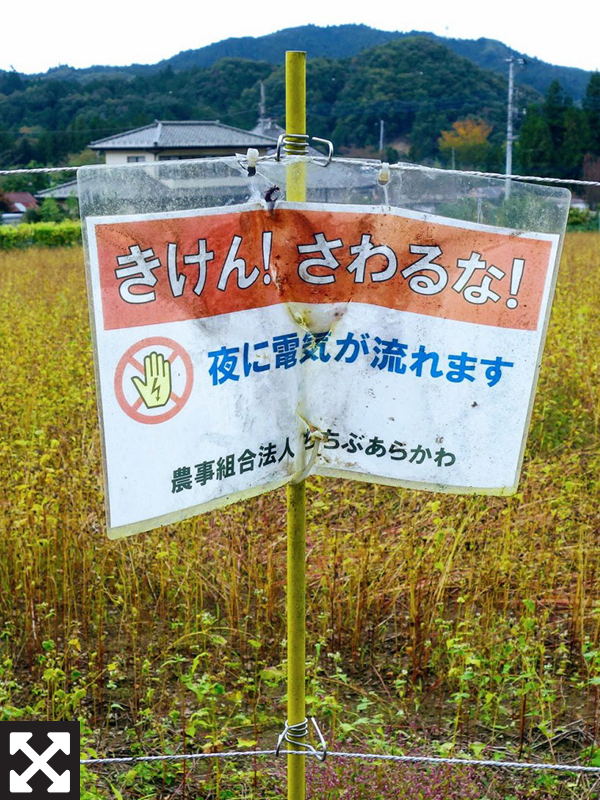
A warning sign asking not to touch the electrical fence used to deter wildlife from farmland in Chichibu, Saitama Prefecture | ALEX K.T. MARTIN
In fact, their proliferation was so fast that the government decided in 2013 on a national goal to halve the numbers of deer and wild boar past 2023. That was followed by a revision to a constabulary on wild animals protection and hunting direction the following year to provide financial support to local governments.
Efforts to adjourn the deer and wild boar populations, including the use of electric fences and wildlife monitoring systems, and the culinary promotion of game meat, seem to be yielding some results.
The Environment Ministry estimates at that place were ii.44 one thousand thousand deer and 880,000 wild boar in Japan in 2017, down from 2.72 million and 890,000 the previous year. Meanwhile, 602,900 deer and 640,100 wild boar were captured in 2019, upward from 572,300 and 604,800 the previous year.
Yet, with two years to go, that's far from the goal of halving the deer population to a little over 1.two meg.
Radical ecological solution
With human predators unprepared to fully meet the claiming, some are calling for a uncomplicated, albeit controversial, solution: reintroduce wolves to Japan in lodge to protect farmland and restore the ecological balance of afflicted areas.
Japan was one time dwelling house to 2 types of wolves: the Hokkaido or Ezo wolf (Canis lupus hattai) native to the northern island of Hokkaido, and the Japanese or Honshu wolf (Canis lupus hodophilax) endemic to the islands of Honshu, Shikoku and Kyushu.
Deified by Hokkaido'south indigenous Ainu people as Horkew Kamuy (Howling God), the Ezo wolf hunted the Yezo deer, amid other animals. But the carnivore's master prey became scarce during the Meiji Era (1868-1912) when settlers from Honshu chased deer for meat and leather. Instead, it began targeting horses — much to the dismay of ranchers.
In response, a bounty system was introduced and American rancher Edwin Dun launched a campaign to exterminate wolves using strychnine-laced baits. Meanwhile, record-breaking snowfalls in 1879 pushed deer to nearly-extinction, further diminishing the wolf population. This subspecies of the gray wolf is thought to have gone extinct in 1896.
The last known specimen of the Japanese wolf, on the other hand, was purchased by American explorer Malcolm Playfair Anderson in 1905. Smaller than the Ezo wolf, information technology was nevertheless worshipped by farmers equally protector of the field during the Edo Catamenia (1603-1868).
The wolf'south revered status gradually eroded after it began preying on horses in the 17th century. According to records, some of the earliest wolf bounties were offered by the Morioka domain in the northern Tohoku region. Studies indicate that, at one point, 35% of Morioka's horses were killed by wolves, extending the notion that the fauna was an enemy of humans.
Meanwhile, rabies appeared amid dogs in the mid 1730s and rapidly spread across Nihon. The disease somewhen reached wolves and turned some into crazed man-killers, triggering large-scale wolf hunts. Deforestation, coupled with a decline of the deer population due to overhunting and the evolution of firearms, also led to the steady depletion of the wolf population.
And during the Meiji Restoration, killing wolves became national policy, while deadly canine distemper epidemics transmitted from Western dogs infected wolves. All these factors are said to take played a role in the animal'due south disappearance from the archipelago.
"According to my estimate, there were probably around 5,000 to x,000 Japanese wolves and two,000 to iii,000 Hokkaido wolves in Japan," says Naoki Maruyama, who heads the Japan Wolf Association, a group that has been lobbying for the reintroduction of wolves.
"Ideally, I'd like to see around twoscore to 50 wolves imported to each of Japan'southward main islands, especially in rural mountainous areas with high deer populations wolves can casualty on," he says.
Maruyama, an honorary professor at the Tokyo University of Agriculture and Technology, tells me that the idea first dawned on him in 1988 when he happened to see a pair of wolves in Poland's Bieszczady National Park while visiting for an bookish conference. While he had been researching the conservation direction of deer and wild boar, this come across provided the missing slice he'd been looking for.
Starting that autumn, he began presenting his thought to reintroduce wolves to academic circles.
"But the more I fabricated my case, the more than people thought I was crazy," he says. "There's a deep-rooted fear of the animal in contemporary Japan. Information technology's seen as a man-eating fauna, like how it'southward depicted in 'Trivial Carmine Riding Hood.'"
Frustrated, he decided to launch his own organization in 1993 to entreatment direct to the public.
Maruyama points to the well-documented ecological benefits of the reintroduction of wolves to Yellowstone National Park in the U.s., and says similar restoration of biodiversity is possible by unleashing grey wolves imported from Russian federation, China or North America to the Japanese countryside in enough numbers to prevent inbreeding.
While the Japanese wolf was considerably smaller than the wolves Maruyama wants to import, he says the animal'southward diet and size will adapt to the landscape and available casualty. But he admits that disarming the public of the claim of such a project has been challenging.
"Part of this problem is the stiff resentment toward alien species and the dangers they may pose," he says, recalling a lecture he gave around two decades ago in Nikko, Tochigi Prefecture.

Professor Naoki Maruyama, founder and president of the Nihon Wolf Clan, has been calling for the reintroduction of wolves into Japan. | THOMAS DELSOL / HANS LUCAS
"On the morning of the event, I received a call at my dwelling while I was getting ready to exit," he says. It was from an aroused female parent in Tochigi who had read a paper commodity nigh the gathering.
"What if my child is attacked past wolves while commuting to schoolhouse!" the adult female yelled. "When I arrived, there were audio trucks parked outside the venue with rightwing nationalists condemning the idea of introducing strange wolves to a nation that was home to the Japanese wolf."
While surveys conducted by Nippon Wolf Association show opposition to the plan decreasing over the years, major inroads are yet to exist fabricated. Ecology and fauna welfare groups point out that Japan has undergone pregnant industrialization since the Japanese wolf was final seen. Trees have been replanted, rivers dammed. Cities are leaving an e'er-growing urban footprint.
How will we know if wolves will be able to survive without causing us damage? Maruyama says answers to all these questions are detailed in his books and on his organization'due south website. Just his principal business concern now, he says, is that he is running out of fourth dimension.
"I'm 78 years erstwhile," he says, "and take been contemplating how many more years I have to exist actively engaged in this mission."
Changing face of forests
The earliest howls of wolves went silent over a century agone in Nippon's forests, vast portions of which were then cut downwardly during World War Two to support the nation's armed services. Post-obit the war, a fasten in demand for timber to feed reconstruction needs saw fifty-fifty more than forests disappear, prompting the regime to launch a nationwide reforestation campaign. Millions of hectares of beech trees were wiped out and replanted with fast-growing conifers such as cypress and cedar.
With Japan'due south trade liberalization of forest products in 1964, however, cheap foreign imports began entering the market place and the evergreens were gradually left unattended, releasing massive amounts of pollen in the atmosphere and triggering hay fever affecting a significant portion of the population to this mean solar day.
"These unharvested forests are as well impacting biodiversity," says Yumiko Tsuruda, executive director of The Nature Conservation Society of Japan.
"Japan's forests account for two-thirds of the nation's full expanse. But 40% are artificially planted forests of more often than not cedar and cypress trees," she says. "Cheap foreign imports mean there is no longer an incentive to invest the time and attempt to conduct proper pruning and thinning to care for them. And alike to the situation with hunters, the forestry workforce is dwindling. The result is night, dense, unhealthy forests."
Tsuruda says Japan's woodlands had been home to a diverse range of deciduous and broadleaf trees providing the necessary ecosystem to support a wide multifariousness of species, including wolves.
"But the degradation of the artificial monoculture forests we see occupying our countryside now has led to a loss of the multifaceted functions of forests," she says.
Overcrowded evergreen forests limit undergrowth, causing surface soil erosion while cutting availability of minerals and vitamins for insects. Meanwhile, nitrogen is flowing from the older commercial plantations into nearby streams and other water sources during rainfall and snowmelt, causing algae blooms.
"These untended forests are increasingly triggering flooding and landslides," Tsuruda says.
This is something I tin can run across for myself actually. The forests surrounding my family's Chichibu cottage are mostly cedar. The gravel road running by the house leading up to the woodlands occasionally gets swept by mudslides during typhoon season and sudden downpours — natural disasters that seem to be occurring with alarming frequency.
Decades of misguided forestry policy are not merely impacting insects and water quality. Chopping downward beech forests has toll local bears their habitat. The moon bear, known for its singled-out white V-shaped patch on its chest, is considered extinct in Kyushu and only a dozen or and so specimens are believed to survive in Shikoku.

Yumiko Tsuruda, executive director of The Nature Conservation Social club of Nihon | ALEX One thousand.T. MARTIN
Efforts are underway to return these forests to a more natural state. Take Akaya Forest, a state-owned 10,000-hectare plot of woodland in the mountains of Gunma Prefecture that the Nature Conservation Society of Japan manages with Forestry Agency staff and local citizens.
Under the project, the surface area is existence replanted and restored dorsum into more various, mixed forests and meadows that can harbor animals like the gold eagle. The about extinct raptor has suffered from a lack of casualty, such as hare, in the nigh bare understory of timber plantations.
And equally with other forests, Akaya is too habitation to a significant deer population. Tsuruda says the organization has introduced a unique method to curb the numbers.
"The idea is to command and maintain the number of deer before they abound out of mitt," she says.
Mineral licks — deposits of salt and other minerals where animals tin get to lick essential nutrients — are strategically placed and monitored in areas with high concentrations of deer to systematically concenter the herbivores to kill them.
Such endeavors, however, still remain rare, and Japan'southward abandoned plantations and booming deer population keep to hurt the ecosystem.
"When wolves roamed our nation'due south wilderness, the forests were brimming with life. A various array of trees, plants, birds and other animals each played its part in maintaining nature's balance, allowing wolves to prosper for generations," Tsuruda says. "Only I'm afraid nosotros've lost that potential. We need to figure out how to rejuvenate our forests to levels worthy of the Japanese wolf."
Phone call of the wild
Sitting atop a steep stone staircase overlooking the onetime village of Arakawa in Chichibu is Wakamiko Shrine. As with other wolf-worshipping shrines that occupy the province, statues of wolves guard the torii gate at the archway of the institution, founded 1,300 years ago during the Nara Period (710-794).
Tadao Kasahara, who has been caput priest there for more than three decades, doesn't know exactly when the shrine began venerating wolves. It appears the four-legged deities were "borrowed" from Ryomen Shrine, a wolf shrine resting deep in the mountains of Chichibu'due south Otaki district, during the early Meiji Era.
In mountainous Chichibu, arable land is scant and the poor soil holds little h2o. Just a few crops are suited for the terrain and climate, Kasahara says, speculating that farmers prayed to wolves to protect what little resources they had from being ravaged past other wild animals.
"Chichibu's dry out state isn't fit for growing rice, then villagers of Arakawa resorted to planting buckwheat used to make soba noodles and mulberry, whose leaves are food for silkworms that supported the region's sericulture," he says. "I believe they prayed to wolves to protect their crops and to help them secure plenty nutrient on their tables to go by during hard times."
It has been 116 years since the Japanese wolf is said to have vanished from the nation's forests. Still, in that location have been persistent reports of claimed sightings of wolves in different parts of the country. Kasahara recalls a tale he used to hear from a practiced friend who would have been around ninety if he were still live.
"He used to boast about hearing a wolf howl in the mountains of Mitsumine," Kasahara says, referring to the peaks that are habitation to Mitsumine Shrine, a mecca for the region'south wolf worship.
"But that must have been around 50 years ago," he says. "Today I tin can just hear monkeys calling each other."

Tadao Kasahara has been head priest of Wakamiko Shrine in Chichibu, Saitama Prefecture, for more than than three decades. | ALEX 1000.T. MARTIN
In an commodity titled "On the Extinction of the Japanese Wolf," researcher John Knight says the "Honshu wolf — whether extinct or not — continues to symbolize something much larger than itself, something about modern Japan as a whole."
"The question of the existence or extinction of the wolf seems to be bound with that of the calibration of modify that has occurred in the mountains," Knight writes. "It is as though the effect of the wolf's beingness is animated by a local nostalgia for the yama (mountains) of the past."
That idea of the wolf as the embodiment of nature and the drastic environmental changes that befell Nihon over the past century has fatigued numerous artists, writers, photographers and others to the beast. And the rich trove of sociology and legends passed down in Chichibu and other rural, mountainous communities offer a window into the creature'due south ecological and cultural significance and why it continues to inspire and then many.
"The wolf is a symbol both of the wild yama and of its control," Knight writes. "Perhaps that is why a formally nonexistent animal continues to preoccupy upland dwellers. If the wolf is extinct, it is non obsolete."
In search of Japan'southward lost wolves
More Deep Dives from The Japan Times
Source: https://features.japantimes.co.jp/4-search-japan-wolves/
0 Response to "Wolf Nature Predator Hunter Family Howling Wolves Figurine Statue Collectible"
Post a Comment